Try the Demo!
Buy it Now!



Ernest Gary Gygax (July 27, 1938 – March 4, 2008) (IPA: [ˈgaj.gæks])12 was an American writer and game designer, best known for co-creating the pioneering role-playing game Dungeons & Dragons (D&D) with Dave Arneson. Gygax is generally acknowledged as one of the fathers of the tabletop role-playing game.3
In the 1960s, Gygax created an organization of wargaming clubs and founded the Gen Con gaming convention. In 1971, he helped develop the Chainmail miniatures wargame, which was based on medieval warfare. He co-founded the company Tactical Studies Rules (TSR, Inc.) with childhood friend Don Kaye in 1973. The following year, he created Dungeons & Dragons with Dave Arneson, expanding on his work on Chainmail and including elements of the fantasy stories he loved as a child. He also founded the magazine The Dragon in the same year, to support the new game. In 1977, Gygax began work on a more comprehensive version of the game, called Advanced Dungeons & Dragons. Gygax designed numerous manuals for the game system, as well as several pre-packaged adventures called "modules" that gave a person running a D&D game (the "Dungeon Master") a rough script and ideas on how to run a particular gaming scenario. In 1983, he worked to license the D&D product line into the successful Dungeons & Dragons cartoon series.
After leaving TSR in 1985 over issues with its new majority owner, Gygax continued to author role-playing game titles independently, beginning with the multi-genre Dangerous Journeys in 1992. He designed another gaming system called Lejendary Adventure, released in 1999. In 2005, Gygax was involved in the Castles & Crusades role-playing game, which was conceived as a hybrid between the game's third edition rules and the classic version of the game created by Gygax.
Gygax was married twice and had six children. In 2004, he suffered two strokes, narrowly avoided a subsequent heart attack, and was then diagnosed with an inoperable abdominal aortic aneurysm, from which he died in March 2008.
Born in Chicago on July 27, 1938, Gygax was the son of Swiss immigrant and Chicago Symphony Orchestra violinist Ernst Gygax,4 and Almina Emelie Burdick.5 The family moved to Lake Geneva, Wisconsin in 1946, just before Gygax's eighth birthday,6 where he lived until his death in 2008. After he dropped out of high school during his junior year, Gygax worked odd jobs for a while, but eventually continued his education by attending night classes in junior college, and by pursuing anthropology classes at the University of Chicago.7
Among his interests were a love of gaming and an appreciation for fantasy and science fiction literature. Gygax started his interest in gaming when he was five, playing card games such as pinochle, and then chess.8 At the age of ten, he would enact what would today be called "live action role-playing games" with his friends, with one of them acting as a referee.9 His interest in science fiction and fantasy stemmed directly from the influence of his father, who had introduced him to pulp novels.10
His interest in games, combined with an appreciation of history, eventually led Gygax to begin playing miniature war games in 1953, with friend Don Kaye; by December 1958 the game Gettysburg from the Avalon Hill company particularly captured Gygax's attention.11 It was also from Avalon Hill that he ordered the first blank hexagon mapping sheets that were available, which he then employed to design his own games.12 Gygax learned about H. G. Wells' Little Wars book for play of military miniatures wargames, and Fletcher Pratt's Naval Wargame book; by 1965 he was active in the wargame hobby for which he wrote many magazine articles. Then Gygax looked for innovative ways to generate random numbers, and used not only common dice (with six sides), but dice of all five platonic solid shapes.13
During the 1960s, Gygax worked as an insurance underwriter14 in Lake Geneva.15 In 1966, Gygax co-founded the International Federation of Wargamers (IFW) with Bill Speer and Scott Duncan.16,17 The IFW was comprised of several wargaming clubs, which served to promote interest in gaming the medieval period of history in particular, and provided a forum for international wargamers.18 In 1967, Gygax organized a 20-person gaming meet in the basement of his home; Gary would later refer to this event as "Gen Con 0."19 In 1968, Gygax rented Lake Geneva's vine-covered Horticultural Hall for $50 to hold the first Lake Geneva Convention, also known as the Gen Con gaming convention for short.20 Gen Con is now one of North America's largest annual hobby-game gatherings,21 and the place where Gygax met Dave Arneson.22
I'm very fond of the Medieval period, the Dark Ages in particular. We started playing in the period because I had found appropriate miniatures. I started devising rules where what the plastic figure was wearing was what he had. If he had a shield and no armor, then he just has a shield. Shields and half-armor = half-armor rules; full-armor figure = full armor rules. I did rules for weapons as well.23
Together with Don Kaye, Mike Reese, and Leon Tucker, Gygax created a military miniatures society, Lake Geneva Tactical Studies Association (LGTSA), with its first headquarters in Gygax's basement.24 In 1969, Gygax founded the Castle & Crusade Society chapter of the IFW.25 Gary left the insurance business and became a shoe repairman to make more time for pursuing his interest in game development.26 In 1970, he began working as editor-in-chief at Guidon Games, a publisher of wargames,27 for which he produced the board games Alexander the Great and Dunkirk in 1971. In 1968, Gygax and Jeff Perren wrote Chainmail, a miniatures wargame that simulated medieval-era tactical combat,28 and it was published in 1971. Gygax also collaborated with Dave Arneson on the naval wargame Don't Give Up the Ship!.
For the second edition of Chainmail published in 1972, Gygax added a Fantasy Supplement to the rules. These included warriors who were monsters of non-human races, drawn from the works of Tolkien and other sources. He also included rules for individual heroic characters, including wizards. For the last he included ten spells that could be used to affect a battle, including lightning bolts, fireballs, and so forth. Dave Arneson adopted the modified rules for his fantasy Blackmoor campaign. While visiting Lake Geneva in 1972, Arneson ran his fantasy game using the new rules, and Gygax immediately saw the potential of role-playing games.29
Developed with Arneson's help from his modified version of Chainmail for his Blackmoor campaign, Gygax wrote "The Fantasy Game", the role-playing game (RPG) that became Dungeons & Dragons (D&D).30 The rules for simulating magic were inspired by the works of fantasy author Jack Vance, and the system as a whole drew upon the work of authors as Robert E. Howard, L. Sprague de Camp, and Fritz Leiber. In 1973, Gygax quit his day job and attempted to publish the game through Avalon Hill, who turned down his offer.31
Gygax left Guidon in 1973, and, with Kaye as a partner founded the publishing company Tactical Studies Rules (later known as TSR, Inc.), with $2,400 for startup costs.32 Brian Blume joined TSR in 1974 as an equal one-third partner, bringing the financing to publish Dungeons & Dragons.3334 Gygax worked on rules for more miniatures and tabletop battle games, including Cavaliers and Roundheads (English Civil War, with Jeff Perren), Classic Warfare (Ancient Period: 1500 BC to 500 AD), and Tractics (WWII to c. 1965, with Mike Reese & Leon Tucker).
Dungeons & Dragons was first released by TSR in January 1974 as a boxed set;3536 a hand-assembled print run of 1,000 copies, put together by hand in Gygax's home,37 sold out in less than a year.3839 In the same year, Gygax created the magazine The Strategic Review with himself as editor,40 and then hired Tim Kask to assist in the transition of this magazine into the fantasy periodical The Dragon,41 with Gygax as writer, columnist, and publisher (from 1978 to 1981).42 Gygax wrote the supplements Greyhawk,43 Eldritch Wizardry,44 and Swords & Spells45 for the original D&D game. With Brian Blume he also designed the wild west-oriented role-playing game Boot Hill in 1975.46 The Dungeons & Dragons Basic Set, geared towards younger players and edited by J. Eric Holmes in 1977, was based largely on Gygax's work on the original D&D boxed set.47
After Kaye's death from a heart attack in January 1976, his widow sold her shares to Gygax.48 Gygax, now controlling the whole of Tactical Studies Rules, created TSR Hobbies, Inc. with himself as president. Gygax, coming into financial troubles soon after, sold TSR Hobbies to Brian Blume and his brother Kevin.
Beginning in 1977, a new version of D&D was created, Advanced Dungeons & Dragons (AD&D). The Monster Manual would be the first supplemental rule book of the new system, with many books to follow.49 The AD&D rules were not compatible with those of D&D, and as a result, D&D and AD&D would have distinct product lines.
Gygax authored the Advanced Dungeons & Dragons hardcovers Players Handbook,50 Dungeon Masters Guide,51 Monster Manual,52 Monster Manual II,53 Unearthed Arcana,54 and Oriental Adventures.55 Gygax also authored or co-authored numerous AD&D & basic D&D adventure modules, including The Keep on the Borderlands,56 Tomb of Horrors,57 Expedition to the Barrier Peaks,58 The Temple of Elemental Evil,59 Forgotten Temple of Tharizdun,60 Mordenkainen's Fantastic Adventure,61 Isle of the Ape,62 and all seven of the modules later combined into Queen of the Spiders.63 In 1980, Gygax's long-time campaign setting of Greyhawk was published in the form of the World of Greyhawk Fantasy World Setting folio,64 which was expanded in 1983 into the World of Greyhawk Fantasy Game Setting boxed set.65 Sales of the Dungeons & Dragons game reached $8.5 million in 1980.66 Gygax also provided assistance on the Gamma World science fantasy role-playing game in 1981, and co-authored the Gamma World adventure Legion of Gold.67 In 1981, Gygax negotiated an agreement for game distribution into the book trade with Random House.68
In 1979, a Michigan State University student supposedly disappeared into the school's steam tunnels while playing a live-action version of D&D. Negative mainstream media attention focused on Dungeons & Dragons as a result. In 1982, Patricia Pulling's son killed himself; blaming Dungeons & Dragons for his suicide, Pulling formed an organization named B.A.D.D. (Bothered About Dungeons & Dragons) to attack the game and the company that produced it. Gygax defended the game on a segment of 60 Minutes,69 which aired in 1985 and also featured Pulling. When death threats started arriving at the TSR office, Gygax hired a bodyguard.70 In 1982, however, TSR's annual D&D sales increased to $16 million,71 and in January 1983, The New York Times speculated that Dungeons & Dragons might become "the great game of the 1980's" in the same manner that Monopoly was emblematic of the Great Depression.72
TSR was split into four companies in 1983. Gygax became the President and the Chairman of the Board of Directors of TSR, Inc.,73 and the President of TSR Entertainment, Inc. As part of TSR Entertainment, Inc. (later Dungeons & Dragons Entertainment Corp.), Gygax went to Hollywood, where he became co-producer of the licensed Dungeons & Dragons animated television show for CBS.74 The series led its time slot for two years.75
While Gygax was involved in the making of the cartoon series and exploring the possibility of a film adaptation of the game (starring Orson Welles), he left the day-to-day operations of TSR to his fellow board members, Kevin and Brian Blume. By the time he came back to Wisconsin in 1984, the company was $1.5 million in debt.76 In response he hired Lorraine Dille Williams to manage the company. The Blumes soon sold their stock to Williams. Gary Gygax then sold his remaining stock and departed TSR in 1985;77 meanwhile, sales of Dungeons & Dragons reached $29 million.
I was pretty much boxed out of the running of the company because the two guys, who between them had a controlling interest, thought they could run the company better than I could. I was set up because I could manage. In 1982 nobody on the West Coast would deal with TSR, but they had me start a new corporation called "Dungeons and Dragons Entertainment." It took a long time and a lot of hard work to get to be recognized as someone who was for real and not just a civilian, shall we say, in entertainment. Eventually, though, we got the cartoon show going (on CBS) and I had a number of other projects in the works. While I was out there, though, I heard that the company was in severe financial difficulties and one of the guys, the one I was partnered with, was shopping it on the street in New York. I came back and discovered a number of gross mismanagements in all areas of the company. The bank was foreclosing and we were a million and a half in debt. We eventually got that straightened out, but I kind of got one of my partners kicked out of office. [Kevin Blume, who was removed as TSR CEO in 1984]. Then my partners, in retribution for that, sold his shares to someone else [Lorraine Williams]. I tried to block it in court, but in the ensuing legal struggle the judge ruled against me. I lost control of the company, and it was then at that point I just decided to sell out.78
Before leaving TSR, Gygax authored two novels for TSR's Greyhawk Adventures series, featuring Gord the Rogue, Saga of Old City79 (the first Greyhawk novel)80 and Artifact of Evil.81 Subsequent Gord the Rogue adventures from New Infinities Productions, Inc. (also published in Italian) included Sea of Death,82 Night Arrant (a collection of short stories),83 City of Hawks,84 Come Endless Darkness,85 and Dance of Demons.86
Another of Gary Gygax's creations was Dragonchess, a three-dimensional fantasy chess variant, published in Dragon #100 (August 1985). It is played on three 8x12 boards stacked on top of each other - the top board represents the sky, the middle is the ground, and the bottom is the underworld. The pieces are characters and monsters inspired by the Dungeons and Dragons setting: King, Mage, Paladin, Cleric, Dragon, Griffin, Oliphant, Hero, Thief, Elemental, Basilisk, Unicorn, Dwarf, Sylph and Warrior.
In the mid 1980s, Gygax worked with Flint Dille on the Sagard the Barbarian Books.87,88,89,90 His other books from the period include Role-Playing Mastery91 and its sequel, Master of the Game.92 Gygax also wrote a number of published short stories.
After leaving TSR, Gygax helped form the company New Infinities Productions, Inc. in 1986,93 and was the Chairman of the Board of Directors until 1988.94 Gygax's first role-playing game work for New Infinities was the science fiction RPG Cyborg Commando, published in 1987 (with Kim Mohan and Frank Mentzer).95 Gygax then created Dangerous Journeys, a role-playing game spanning multiple genres,96 published by Game Designers' Workshop (GDW),97 and which led to a lawsuit from TSR.98 Gygax authored all of the products for Dangerous Journeys, including Mythus,99 Mythus Magick,100 Epic of Ærth (a companion volume to the Mythus Game),101 Necropolis (an adventure scenario),102 and Mythus Bestiary.103 He subsequently wrote a number of fantasy novels, before beginning work in 1995 on a new RPG. Originally intended as a computer game, Gygax released it as Lejendary Adventure in 1999. One key design goal was simple gaming rules, as Gygax felt that role-playing games were becoming discouragingly complex. Books that Gygax wrote for the Lejendary Adventure series include The Lejendary Rules for All Players,104 Lejend Master's Lore,105 and Beasts of Lejend.106 He also authored or co-authored the three books in The Chronicles of the Lejendary Earth, including Lejendary Earth Gazetteer,107 Noble Kings and Dark Lands,108 and The Exotic Realms of Hazgar.109
Gygax wrote three more novels during the 1990s, released under publisher Penguin/Roc, and later reprinted by Paizo Publishing: The Anubis Murders,110,111 The Samarkand Solution,112,113 and Death in Delhi.114,115 Paizo Publishing also printed Infernal Sorceress, Gygax's "lost" novel.116
Gygax worked on a number of releases with the d20 System under the Open Game License. These included: A Challenge of Arm's117 and The Ritual of the Golden Eyes118 generic adventure modules; The Weyland Smith & Company Giant Fun Catalog ("Joke" Magic Items);119 and The Slayer's Guide to Undead120 and The Slayer's Guide to Dragons121 sourcebooks. Gygax also appeared as the primary author of the entire 64-page magazine in Mythic Masters (Trigee) magazine for each of six issues published through 1994.
Gygax also worked on the Gygaxian Fantasy Worlds Series from Troll Lord Games, editing volumes IV, V, VI, and VII. This series included: Volume I Gary Gygax's The Canting Crew, which explores the underworld of city life;122 Volume II Gary Gygax's World Builder, a collection of organized definitions, lists, tables and charts;123 Volume III Gary Gygax's Living Fantasy, everyday life;124 Volume IV Gary Gygax's Extraordinary Book of Names, containing name generators;125 Volume V Gary Gygax's Insidiae, covering adventure design;126 Volume VI Gary Gygax's Nation Builder, building on the material in Living Fantasy and World Builder;127 Volume VII Gary Gygax's Essential Places, containing various detailed locations;128 and Volume VIII Gary Gygax's Cosmos Builder, covering dimensions and other worlds.129
In 2005, Gygax returned to the Dungeons & Dragons RPG with his involvement in the creation of the Castles & Crusades system with Troll Lord Games. Troll Lord Games published Castle Zagyg, the previously unreleased original version of Gygax's Castle Greyhawk, with the original dungeon setting for D&D. The Castle Zagyg publications are a planned series of seven sourcebooks, which for trademark reasons are not actually published under the name of Greyhawk. Volumes released so far include Yggsburgh,130 Dark Chateau,131 The East Mark Gazetteer,132 and The Upper Works.133 In 1999, Gygax designed the adventure Against the Giants: The Liberation of Geoff with Sean K. Reynolds for TSR.134
Gygax lent his voice to cartoons and video games in his later life, including providing the voice for his cartoon self in the episode "Anthology of Interest I" of the TV show Futurama, which aired in 2000.135 Gygax also performed voiceover narration as a guest Dungeon Master in the massively multiplayer online role-playing game Dungeons & Dragons Online: Stormreach.136
Gygax married his first wife, Mary Jo Gygax, in 1958. By 1961 they had two children – Ernie and Elise – who would later assist with play-testing Dungeons & Dragons.137 Three more children were to follow - Heidi, Cindy, and Lucion (Luke)138 - before the marriage ended in divorce. On August 15, 1987, (the same day as his parents' 50th wedding anniversary), he married his second wife, Gail Carpenter,139 and together they had his sixth (and last) child, Alexander. By 2005, Gygax had seven grandchildren. He continued to reside in Lake Geneva, Wisconsin, as he had since his family first arrived in 1946.140
Gygax died the morning of March 4, 2008, at his home in Lake Geneva, Wisconsin, aged 69.141,142 He was in semi-retirement,143 having almost suffered a heart attack after receiving incorrect medication to prevent further strokes after those on April 1 and May 4, 2004. He was diagnosed with an inoperable abdominal aortic aneurysm. Gygax was a lifelong smoker, but was forced to switch to cigars after his strokes. Even while his health failed, gaming remained very much a part of his life. Gygax was still active in the gaming community and had active Q & A forums on gaming websites such as Dragonsfoot and EN World.
I would like the world to remember me as the guy who really enjoyed playing games and sharing his knowledge and his fun pastimes with everybody else.144
Gary Gygax received several awards related to gaming,145 including the Academy of Adventure Gaming Arts & Design Origins Award Hall of Fame 1980.146
Sync Magazine named Gygax #1 on the list of "The 50 Biggest Nerds of All Time".147 SFX Magazine listed him as #37 on the list of the "50 Greatest SF Pioneers".148 In 1999 Pyramid magazine named Gary Gygax as one of The Millennium's Most Influential Persons "in the realm of adventure gaming."149 Gygax was tied with J. R. R. Tolkien for #18 on GameSpy's 30 Most Influential People in Gaming.150
Gary Gygax was commemorated in a number of webcomics, including xkcd's comic #393 "Ultimate Game,"151 Penny Arcade's "Bordering On The Semi-Tasteful,"152 Dork Tower's "Thanks for the Worldbuilding Rules,"153 Order of the Stick #536,154 and GU Comics' "The Journey's End."155
Numerous names in Dungeons & Dragons, such as Zagyg, Ring of Gaxx, and Gryrax, are anagrams or alterations of Gygax's name.156 A strain of bacteria was also named in honor of Gygax, "Arthronema gygaxiana sp nov UTCC393".157
Blizzard Entertainment dedicated the 2.4.0 patch to World of Warcraft, "Fury of the Sunwell", to Gary Gygax.158 Electronic Arts dedicated Publish 51 in Ultima Online to Gary Gygax. This included a new room in the dungeon Doom containing a special encounter and unique decorations.159 Turbine, Inc. included two tributes in the Dungeons & Dragons Online: Stormreach Module 7, released June 3 2008: A new area in Delera's Graveyard containing a memorial marker and text, and a new unique item, Voice of the Master, that improves the wearer's experience awards.160,161
Stephen Colbert, an avid D&D gamer in his youth,162 dedicated the last part of the March 5th episode of The Colbert Report to Gygax.163
The Futurama movie Futurama: Bender's Game is dedicated to Gygax, with an animated image of him appearing after the credits.164 All three Dungeons & Dragons 4th edition core rulebooks are also "dedicated to the memory of E. Gary Gygax."165,166,167
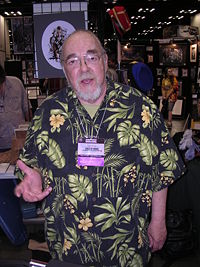 Born: July 27, 1938, Chicago, Illinois
Died: March 4, 2008 (aged 69), Lake Geneva, Wisconsin
Occupation: Writer, game designer
Nationality: United States
Author: 1971–2008
Genres: Role-playing games, fantasy, wargames
Influences: J. R. R. Tolkien, Robert E. Howard, L. Sprague de Camp, Fletcher Pratt, Fritz Leiber, Poul Anderson, A. Merritt, H. P. Lovecraft168, Jack Vance, Michael Moorcock.
Article from Wikipedia, the free encyclopedia.
All text is available under the terms of the GNU Free Documentation License.
 RSS feed